
The University of Georgia is the state’s flagship institution of higher education. Chartered in 1785, the University of Georgia is the nation’s first state-chartered university. As the first land grant institution in the nation and the capstone of the Georgia Board of Regents University System, the university’s teaching, research, and service missions focus enormous resources to improve the quality of life throughout Georgia and the nation. We hope you enjoy looking back on some of our history!
-
In 1969, the River’s Crossing building, built with federal funds, opens its doors in September. The Athens Unit of the Georgia Retardation Center, later to become the Center on Human Development and Disability, provides: (1.) Classroom education for children with disabilities from 28 northeast Georgia counties. Three classrooms are administered by FACS and five by the UGA College of Education. (2.) Overnight accommodations for children who live too far away to commute daily to school. (3.) Internship and practicum opportunities for UGA students from 14 disciplines representing five UGA schools and colleges.

-
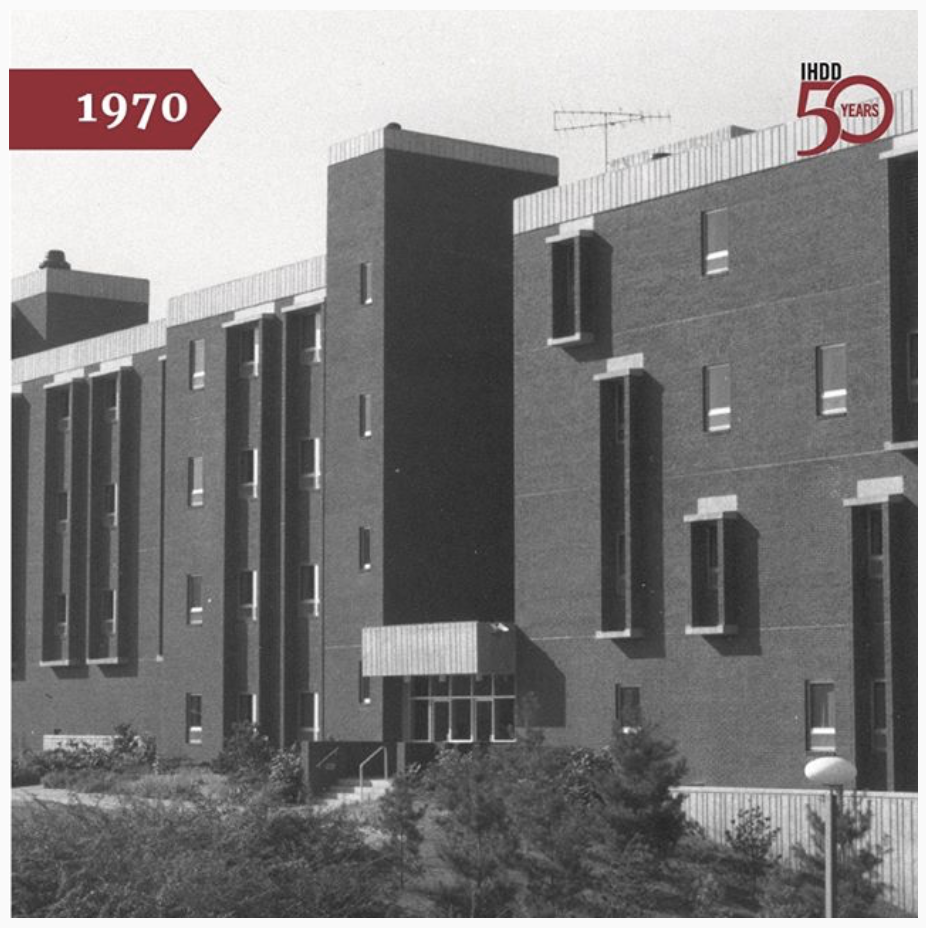
In 1970, the River’s Crossing building in 1970. IHDD’s offices are still in River’s Crossing building today.
-
In 1975, the Education for Handicapped Children Act (renamed the Individuals with Disabilities Education Act, IDEA, in 1990) guarantees a free, appropriate public education for all children with disabilities. IHDD served preschoolers from its inception. In 1975, a mobile unit provides diagnostic and educational services for young children living in rural areas.

-
In 1976, Georgia’s first in-home intervention program for families of infants with disabilities is established.

-
In 1977, IHDD conducts a needs assessment in six Georgia counties focused on aging people with disabilities. It is the first effort in Georgia to understand the service needs of an aging population. In the 1980s and 1990s, IHDD uses the arts to include seniors with lifelong disabilities in senior centers and builds collaboration between Georgia’s aging and disability service networks.

-
In 1978, Parent Helpers is established as the first Georgia program offering peer support to families of newly diagnosed children with disabilities. The program merges with Parent to Parent of Georgia in 1982. IHDD disseminates the model nationally in 1984 and internationally through the Air Force in 1986. Also, IHDD hosts the regional activities of Marc Gold, whose innovative training strategies demonstrate that individuals with the most significant disabilities can be employed.

-
In 1983, IHDD begins to include children with disabilities at the Child Development Lab at the McPhaul Center, culminating in 1985 with the establishment of one of the state’s first inclusive preschool programs.

-
In 1989, IHDD moves administratively from the College of Education to FACS.

-
In 1990, the Americans with Disabilities Act becomes law, a far-reaching law providing civil rights protections to people with disabilities.

-
In 1994, the IHDD Consumer Advisory Council holds its first meeting. Also, the Georgia Personal Assistance Corps, one of the first AmeriCorps projects, is funded as one of three corps actively recruiting people with disabilities to provide service to their communities. In 2001, Everyone Can Serve disseminates the inclusive service model nationally.

-
In 1996, River’s Crossing becomes the first Georgia institution for individuals with disabilities to close; students who moved to the community are followed for 10 years by IHDD researchers, with very positive outcomes documented.

-
In 1998, IHDD officially becomes an institute.

-
In 1999, The U.S. Supreme Court rules in the landmark Olmstead case that under the Americans with Disabilities Act, isolating people with disabilities in segregated residential institutions constitutes discrimination based on disability. The case, which originates in Georgia, is a major victory for disability rights advocates. IHDD becomes the primary supporter of People First of Georgia, a self- advocacy network, and takes responsibility for assisting self-advocates in coordinating the next 11 annual statewide People First conferences.

-
In 2003, IHDD supports Lois Curtis and Elaine Wilson, the plaintiffs in the Olmstead case, to develop small businesses: Lois as a folk artist and Elaine as a public speaker.

-
In 2004, the First IHDD classes are offered at UGA.
-
In 2005, the Children’s Freedom Initiative is formed. CFI is a collaborative effort to ensure that children who live in facilities are given the chance to live with permanent, loving families. Also, FarmAgain’s AgrAbility project is funded. It is designed to assist farmers and other agricultural workers with disabilities and chronic health conditions with assistive technology solutions.

-
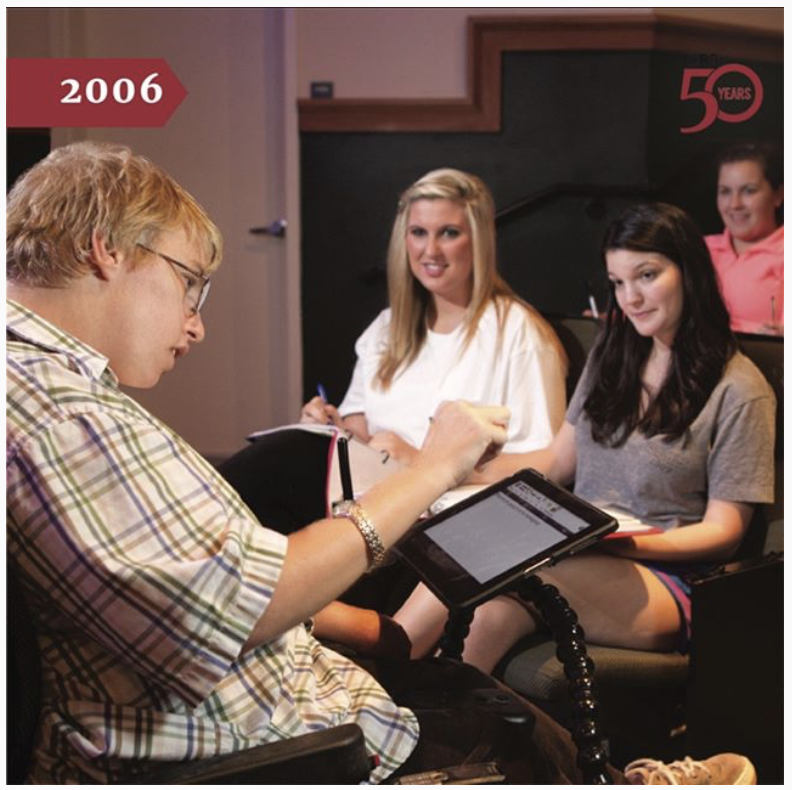
In 2006, graduate and undergraduate Disability Studies Certificate programs are approved. The first three students graduate with Disability Studies Certificates in 2008.
-
In 2013, IHDD, the UGA Richard B. Russell Special Collections Libraries and the Shepherd Center in Atlanta found the Georgia Disability History Alliance to preserve the state’s disability history. GDHA sponsors an annual Disability History Symposium.

-
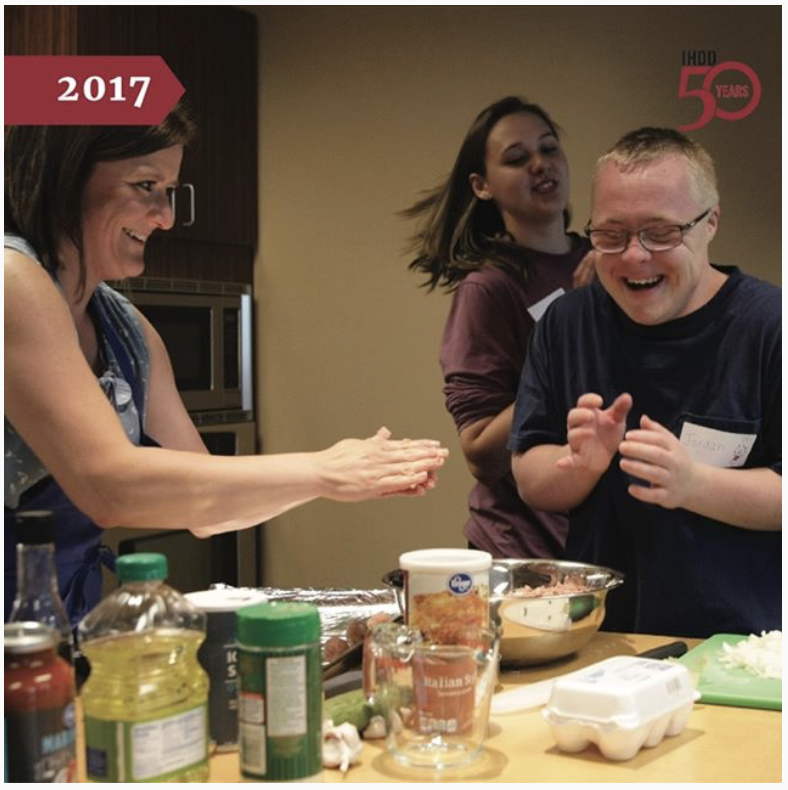
In 2017, the Destination Dawgs program for students with intellectual and developmental disabilities is launched. The first cohort of five students receive a Certificate in College and Career Readiness and the group is recognized at both FACS Convocation and UGA Commencement in May 2019. More than 80 UGA students serve as peer mentors during spring semester 2019.
-
In 2019, IHDD turned 50!

-
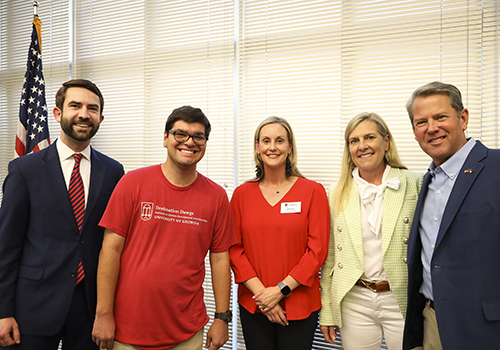
The Georgia Legislature passes a bill that covers tuition for students in IPSE programs, similar to the HOPE Scholarship program. Destination Dawgs student Ben Harrison and director Lisa Ulmer attend the signing ceremony with local representative Houston Gaines, an early advocate of the program going back to his time as president of the UGA Student Government Association. They are shown here with Georgia Governor Brian Kemp and his wife, Marty.
-
Georgia Governor Brian Kemp signs the Georgia as Model Employer (GAME) legislation into law. GAME was created to increase the recruitment, hiring, promotion and retention of individuals with disabilities within state of Georgia employment. Shown here are CHDD’s Doug Crandell, a Public Service Faculty and Director of the Advancing Employment project, Charlotte Densmore and D’Arcy Robb from the Georgia Council on Developmental Disabilities and Senator Billy Hickman, who carried the bill.
In 2025, the Georgia Dignity and Pay Act (SB 55) mandates that employers in Georgia pay individuals with disabilities the full minimum wage, eliminating the practice of paying subminimum wages. CHDD’s Doug Crandell is a major champion of the legislation.

-
IHDD becomes the Center on Human Development with Disability (CHDD)

-
CHDD extends our inpact by joining the David Ralston Institute for Behavioral Health and Developmental Disabilities within the University system framework.
